
Smart Mobile Reduces Costs and Increases Security at Higher Ed Campuses
Administrators need to keep safety and security top of mind with crime on the rise at educational facilities across the U.S. According to the FBI’s “Crime in Schools, 2020-2024” special report issued in April 2025, there were over one million incidents at educational facilities involving approximately 1.5 million victims and 1.2 million offenders. A large percentage of these incidents resulted from external sources where individuals were able to gain unauthorized access to facilities. These alarming crime statistics present campus administrators and security personnel with the challenge of maintaining open and inviting environments while at the same time, closely monitoring, controlling, and managing who has access to their facilities.
The A Security Imperative for Higher Education
Access control is crucial for enhancing security and safety across higher education campuses, but conventional access control solutions can be expensive to install, implement, and maintain. Physical access credentials like cards and fobs require robust management and supervision to onboard and offboard user identities, and ensure that missing credentials are voided and replaced, adding another layer of expense. However, modern solutions utilizing smartphones and wireless hardware provide many significant benefits with fewer barriers of entry for both new system installations and when expanding existing systems, including:
- Enhanced overall security by controlling access to student dormitories, admin offices, classrooms, food preparation and service facilities, sports facilities, as well as maintenance, storage, and inventory areas.
- Simplified visitor management allowing admins and campus police to always know who is on campus—including visitors and contracted workers—based on scheduled permissions to specific areas on campus.
- Protection of high-risk areas such as HVAC and power facilities, fleet and maintenance garages, server rooms, and research laboratories.
- Emergency lockdown capabilities enabling the ability to instantaneously and remotely lock down or open any specific facility, any combination of facilities, or the entire campus on a moment’s notice.
- Cost reductions and future savings by eliminating physical credentials and their associated management expenses.
- Detailed record-keeping and compliance with electronic logs of all access activity across campus for compliance audits, policy reviews, and forensic investigations.
- Easy expansion and scalability to accommodate ongoing renovations to existing facilities and new construction.
- Greater inclusivity and improved ADA accessibility for students and staff through hands-free, smartphone-based entry.
A Smarter Access Alternative
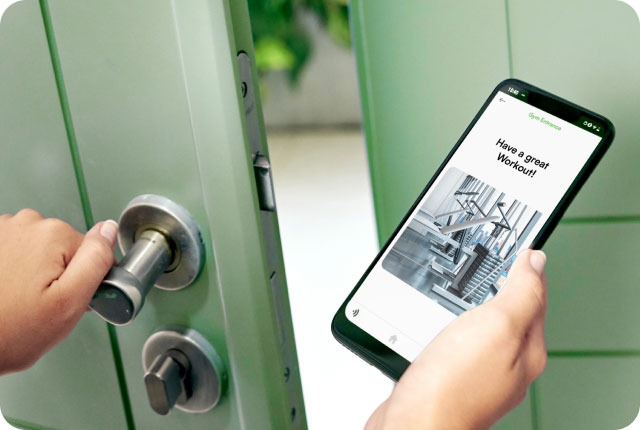
Modern access solutions utilizing smartphone credentialing improve overall security and safety, reducing shrinkage, deterring vandalism, and simplifying daily operations. It also puts access management at the fingertips of higher education admins and police without the cost and complexity of traditional access control platforms. Simplifying electronic access control with managed mobile credentials allows system admins to instantly and remotely create or revoke access permissions, granting permissions-based entry to specific campus locations and/or multiple facilities. If a student leaves the school, or a specific worker quits or is terminated, their access privileges can be revoked in seconds from any remote location by an authorized admin. This removes the time and expense of managing and/or recovering physical credentials. The same ease of termination and enrollment applies to onboarding new students, employees, and visitors. In addition, mobile credentials on smartphones can integrate with HR and scheduling software, helping ensure that only the employees who are scheduled to work can enter restricted areas at the appropriate times.
Mobile Also Means Wireless
Conventional access systems require expensive controllers, hardwiring, power, and dedicated IT support, which often puts electronic access control out of reach for many higher education facilities. Battery-powered surface mounted strikes and door handles with embedded access software do not require internet connectivity, hardwired connections, or local power at each door, making installation and implementation fast, easy, and much more affordable. The lower cost of entry also results in lower total cost of ownership (TCO) by eliminating future expenses related to system expansion, expendable physical credentials, and system management.
Access Control with Privacy and Trust
Maintaining personal privacy is also critical when considering electronic access control. Collecting excess personal data or facial images without specific consent can result in both non-compliance and hefty fines, especially with new and emerging regulations like the Illinois Biometric Information Privacy Act (BIPA). New modern access solutions like Kindoo require minimal personal data without any sacrifices to security. It also features embedded encryption to enhance security without compromising campus data or individuals’ privacy.
Conclusion
Higher education campuses have long relied on physical devices to control access, but traditional access control systems present too many barriers to entry. They’re expensive to install, implement, and sustain, require expendable credentials that are difficult to manage, and ultimately do not provide adequate protections against unauthorized entry to areas that should be secured.
Modern mobile access control solutions overcome these challenges by combining ease of deployment with robust security, extreme flexibility, and affordability. Modern high-performance yet cost-effective solutions pave the way for higher education facilities to better protect themselves and maintain open, safe, and secure environments that are more conducive to learning.
Click here to read the full article on Security Journal Americas Website
Articles about the latest trends in the Access Control and Security industries. Written by the team at Kindoo.
Learn More About Kindoo
Curious to learn more about Kindoo?

Curious to learn more about Kindoo?