
Breaking Down Longstanding Barriers to Access Control
The demand for electronic access control continues to increase as organizations across all vertical markets seek more efficient and cost-effective means to better protect their people, property, and assets. New and emerging threats combined with the emergence of more dynamic facilities require a more flexible and pragmatic approach to controlling entry, managing access, changing permissions, and maintaining compliance.
Conventional access control systems have traditionally been approached as a fixed infrastructure project. Systems were hard-wired and expected to last for years, with limited flexibility after deployment. The combination of high costs, installation and site management complexities, and scalability made traditional access control inaccessible for a large base of users—and difficult for systems integrators and installing dealers to integrate into their portfolio of services. For SMBs and organizations managing multiple locations, the investment can be difficult to justify.
The business model and justification for electronic access control systems are changing to meet both users’ and installers’ needs. New solutions are more adaptable—driven by improvements in wireless connectivity, mobile credentials, and cloud-based management. They reduce cost and complexity, making modern access control systems easier to deploy, manage, and scale than legacy counterparts.
The Limitations of Traditional Systems
Access control has become the first line of defense in the era of hybrid workforces. Systems need to keep up with this paradigm shift in business operations. Systems that are difficult to manage and scale can actually be counterintuitive, making it difficult to secure entry points and enforce security policies across multiple doors and locations. Over time, organizations often spend more addressing problems reacting to challenges than focusing on preventive and proactive access control.
Much of this friction is caused by how traditional access control systems are deployed. Expensive cabling, disruptive installation work, and high upfront capital costs often made electronic access control prohibitive. Expanding coverage across additional doors or sites is labor intensive making scalability a continuous challenge. These systems also require a level of IT acumen by both installers and users, which presents another common barrier to entry.
The constraints of conventional electronic access control affect organizations of all sizes. SMBs have foregone installation due to the high costs of installation and management for electronic access control. Larger multi-site businesses also find it difficult to measure return on investment (ROI) and maintain standardization across locations. In both cases, ROI concerns have led many organizations to defer access control modernization, even as risk and operational pressure continue to increase.
The Advantages of Modern Access Control
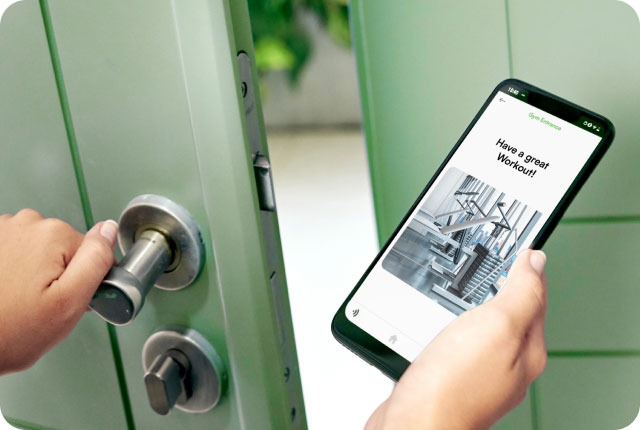
The core technologies of modern access control aren’t defined by a single technology. Instead, these systems enable wireless communications between all connected electronic locking devices and utilize mobile credentials—eliminating the need for physical access credentials. This reduces the need for extensive and expensive cabling while eliminating the cost and risk of lost, stolen, and easily replicated physical access credentials. Additionally, cloud-based management makes system administration easier than ever.
On their own, wireless mobile access technologies modernize specific tasks. When used together, they transform electronic access control, simplifying deployment and reducing infrastructure requirements. Issuing, changing permissions, or revoking credentials is fast and easy from a smartphone. The cloud enables remote management, so users can oversee multiple doors and locations from anywhere, allowing for seamless integration into the larger security ecosystem.
A recent industry report confirms growing adoption of cloud and mobile solutions. Estimates expect an 8-10% Compound Annual Growth Rate (CAGR) and total industry value of $15.8 billion by 2030. Demand for modern, flexible systems is expanding.
The Cost/Performance Advantage
For users and integrators alike, the cost/performance benefits of adopting new modern access control solutions are far reaching. A reduction in installation and ongoing maintenance expenses directly equates to a lower Total Cost of Ownership (TCO) for organizations. Ongoing maintenance and scalability are simpler, requiring less labor, time, and expense. Modern wireless and cloud driven access control solutions eliminate the need to overhaul complex infrastructure and allow organizations to scale systems as needed. All these benefits also improve the user experience, making access simpler and seamless for employees, visitors, and contractors. Subscription-based models make budgeting easier, shifting away from large one-time capital expense projects to modular scaling when and if needed.
An Easier Pathway to RMR
Integrators and resellers will find that modern access control solutions drive enhanced Recurring Monthly Revenue (RMR) opportunities. Beyond installation, leveraging a subscription model keeps you close to the customer for additional assessments, expansion, and maintenance. Since these systems require less specialized work, integrators can better convey the ROI to a broad range of customers, including SMBs who were previously underserved. This model also facilitates building long-term customer relationships, versus relying solely on one-off projects.
A Long-Term Strategy for Resellers
Wireless and mobile access control systems deliver sustainability across operations, ROI, and the environment. Easy upgrades support longer system lifecycles, preventing repeated hardware updates. Organizations can add or expand coverage without tearing out and replacing existing infrastructure. This also leads to a reduction in physical waste. Solutions operate and scale better over the long run, future-proofing access for SMBs and multi-site businesses.
Making High-Performance Access Control Accessible
Wireless connectivity, mobile credentials, and cloud-based management are transforming the access control landscape. Reduced installation complexity, lower costs and easier scalability have democratized high-performance solutions for organizations that were previously priced out. Complex infrastructure deployments are a thing of the past. Modern solutions like Kindoo open the door to affordable, high-performance electronic access control for a wider range of users—while providing systems integrators and installing dealers with an easy and profitable way to expand and grow their businesses. Truly a win-win proposition.
Click here to read the article on the VSS Perspectives website
Articles about the latest trends in the Access Control and Security industries. Written by the team at Kindoo.
Learn More About Kindoo
Curious to learn more about Kindoo?

Curious to learn more about Kindoo?